
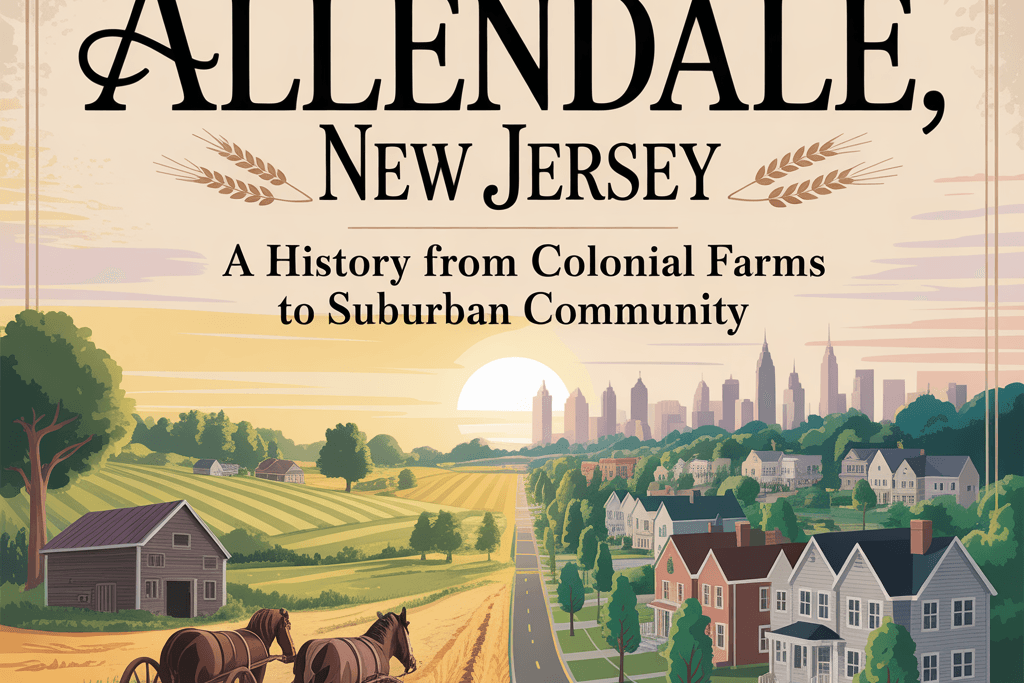
Allendale, New Jersey: A History from Colonial Farms to Suburban Community
Allendale, a borough in Bergen County, New Jersey, occupies approximately three square miles in the northeastern part of the state, roughly 25 miles from New York City. The area’s transformation from colonial farmland to an incorporated municipality reflects broader patterns of development that characterized northern New Jersey over three centuries.
Indigenous Peoples and Early European Contact
Before European settlement, the Allendale area was inhabited by Lenni-Lenape people, specifically groups associated with the Hackensack and Tappan bands. These indigenous communities utilized the region’s waterways, forests, and fertile land for fishing, hunting, and agriculture. The Lenape established seasonal camps and maintained trails that would later influence the paths of colonial roads.
European contact began in the early 17th century when Dutch traders and settlers arrived in the broader region. The Dutch established New Netherland, which encompassed much of present-day New York, New Jersey, and Delaware. However, the specific area that would become Allendale remained largely unsettled by Europeans during the Dutch colonial period (1609-1664).
English Colonial Period and the First Settlers
When England took control of New Netherland in 1664, renaming it New York and New Jersey, the region began to see more systematic European settlement. The province of East Jersey, which included Bergen County, was divided into large proprietary grants.
The first European settlers in the Allendale area arrived in the late 17th and early 18th centuries. These early inhabitants were predominantly Dutch and English families who established farms on land purchased or granted through colonial authorities. The area’s rolling terrain, wooded sections, and access to waterways made it suitable for agriculture and livestock raising.
Among the earliest family names associated with the area were the Ackermans, Coeymans, and other Dutch families who had migrated from the Hudson River Valley and earlier settlements in Bergen County. These families established farmsteads that would remain in operation for generations.
The Agricultural Era: 18th and Early 19th Centuries
Throughout the 18th century and into the early 19th century, the Allendale area remained primarily agricultural. Farms produced grains, vegetables, dairy products, and raised livestock. The scattered farmsteads were connected by rough roads, and the nearest commercial centers were in established towns like Hackensack and communities along the Hackensack River.
The land that would become Allendale fell within the boundaries of several different townships during this period. Originally part of Bergen Township (one of the oldest townships in New Jersey, dating to 1693), the area underwent various administrative reorganizations as Bergen County’s population grew and new townships were carved from existing ones.
During the American Revolution (1775-1783), northern New Jersey saw significant military activity due to its location between British-occupied New York City and the Continental Army’s positions. While no major battles occurred specifically in the Allendale area, the region experienced the movement of troops, requisitioning of supplies, and the general disruptions common to areas in the theater of war. Local farmers dealt with both British and Continental forces seeking food, fodder, and shelter.
The Arrival of the Railroad: Mid-19th Century Transformation
The most significant development in Allendale’s early history came with the arrival of the railroad. The Paterson and Ramapo Railroad, later reorganized as the New Jersey and New York Railroad, extended a line through the area in the 1840s. In 1848, a station was established in what would become Allendale.
The station was initially called “Arrowsmith’s Station” after John Arrowsmith, who owned property in the area. The name was later changed to “Allen’s Dale,” reportedly after William Allen, a New York surveyor who purchased property near the station in the 1840s. The name “Allen’s Dale” eventually became “Allendale.”
The railroad connection transformed the area from isolated farmland into a location with direct access to markets and transportation networks. Farmers could ship their produce more efficiently to New York City and other markets. The station also made the area accessible to people who might consider living in a more rural setting while maintaining connections to urban employment.
Formation of Franklin Township and Early Community Development
In 1797, the area that included Allendale became part of the newly formed Franklin Township, which separated from Saddle River Township. Franklin Township was a large, predominantly agricultural township that encompassed several areas that would later become independent municipalities.
Throughout the 19th century, the area around the Allendale railroad station gradually developed a small hamlet. A few businesses established themselves near the station—a general store, a post office (officially established in 1855), and services catering to local farmers and travelers.
The community remained small and rural through the Civil War era (1861-1865). Local men served in New Jersey regiments, though records specific to Allendale residents from this period are limited, as the area was not yet an independent municipality.
Late 19th Century: Gradual Growth
The late 19th century brought modest growth. Several factors contributed to slow but steady development:
The railroad made the area increasingly attractive to wealthy New York families seeking summer homes or country estates. Some larger properties were purchased by urban residents who built substantial homes set on multiple acres, enjoying a rural atmosphere while maintaining relatively easy access to the city.
The local population remained predominantly engaged in agriculture, but the community began to develop more commercial activity. Additional stores, a school, and churches served the growing population.
In 1894, portions of Franklin Township were set off to form the Borough of Ramsey, Allendale’s neighbor to the north. This reorganization reflected the broader trend in northern New Jersey toward creating smaller, more manageable municipal units.
Incorporation as a Borough: 1894
On November 10, 1894, Allendale was incorporated as an independent borough by referendum, separating from Franklin Township. The movement toward incorporation reflected the desire of local residents for greater control over local affairs, particularly regarding taxation, schools, and infrastructure development.
At the time of incorporation, Allendale’s population was approximately 500-600 residents. The borough covered roughly three square miles and remained predominantly rural, though the area around the railroad station had developed into a recognizable village center.
The first borough government was established, with elected officials taking responsibility for roads, public safety, and other municipal functions. Early borough records indicate concerns typical of rural communities: maintenance of dirt roads, provision of street lighting (initially gas lamps), and management of local schools.
Early 20th Century: Slow Suburban Development
The early decades of the 20th century saw Allendale begin a gradual transition from farming community to suburban residential area, though this process occurred much more slowly than in communities closer to New York City.
The borough remained relatively undeveloped compared to neighboring areas. Large farms still dominated the landscape. The Cragmere Park area, which had been developed as a summer resort community in the 1880s-1890s with a small lake and cottages, continued to attract seasonal residents.
The construction of improved roads, particularly the development of state and county road systems in the 1910s and 1920s, increased accessibility. The automobile began to replace the railroad as the primary means of transportation for many residents, though the Erie Railroad (successor to earlier railroad companies) continued to provide commuter service.
During World War I (1917-1918), Allendale residents participated in war support efforts, with local men serving in the armed forces. The borough, like communities across the country, organized Liberty Bond drives and other home front activities.
The Interwar Period: 1920s-1930s
The 1920s brought increased development pressure. The post-World War I economic boom led to greater suburban expansion throughout northern New Jersey. However, Allendale’s development remained relatively modest compared to communities with more direct access to major highways.
The borough’s population grew slowly, reaching approximately 1,200 by 1930. New homes were constructed, though large undeveloped tracts and working farms remained common. The downtown area around the railroad station expanded modestly, with additional commercial establishments serving local residents.
The Great Depression of the 1930s slowed development significantly. Construction declined, and some residents faced economic hardship. However, Allendale’s character as a residential community of modest size meant it avoided some of the more severe economic dislocations experienced by industrial cities.
New Deal programs provided some infrastructure improvements. The Works Progress Administration (WPA) and Civilian Conservation Corps (CCC) undertook projects in Bergen County, though specific large-scale projects in Allendale itself were limited given the borough’s small size.
World War II Era: 1940s
World War II brought renewed economic activity and significant social change. Allendale residents served in the armed forces, and the community organized civil defense efforts, scrap drives, and war bond campaigns.
The post-war period marked the beginning of Allendale’s most significant transformation. Returning veterans, the baby boom, and post-war prosperity created enormous demand for housing. Suburban development, which had proceeded slowly in Allendale for decades, was about to accelerate dramatically.
By 1950, Allendale’s population stood at approximately 2,600—more than double the 1930 figure. The borough was on the cusp of the suburban expansion that would fundamentally alter its character over the following two decades.
Physical Development and Infrastructure
Throughout this early period, Allendale’s physical infrastructure developed gradually:
Roads: Early roads were unpaved and maintained by the township and later the borough. The Allendale-Saddle River Road (later Route 17) became an important north-south route through the area. Paving of major roads began in the 1920s and 1930s.
Utilities: Electricity arrived in the early 20th century. Water and sewer systems were developed incrementally, with some areas relying on wells and septic systems well into the mid-20th century.
Schools: One-room schoolhouses served the area in the 19th century. The borough established its own school district after incorporation, constructing school buildings as enrollment grew.
Religious Institutions: Several churches were established in the late 19th and early 20th centuries, serving Protestant denominations that predominated among the largely Anglo-Dutch population.
A Community in Transition
By the mid-20th century, Allendale had evolved from isolated colonial farmland through phases as an agricultural community, a railroad hamlet, and finally a small residential borough. The area had been inhabited by Lenape peoples, settled by Dutch and English farmers, connected to broader networks by the railroad, and incorporated as an independent municipality.
The transformation from farms to homes—which would accelerate dramatically in the 1950s and 1960s—had deep historical roots in the railroad’s arrival, the borough’s incorporation, and the gradual development of the early 20th century. Understanding this earlier history provides context for Allendale’s subsequent development and its evolution into the community it became in later decades.
The historical record of Allendale reflects patterns common to many northern New Jersey communities: indigenous inhabitation, colonial settlement, agricultural development, transportation improvements, suburban transition, and municipal incorporation. Yet each community’s specific chronology and character remained distinct, shaped by geography, timing of key developments, and the decisions of generations of residents who built and governed their local community.